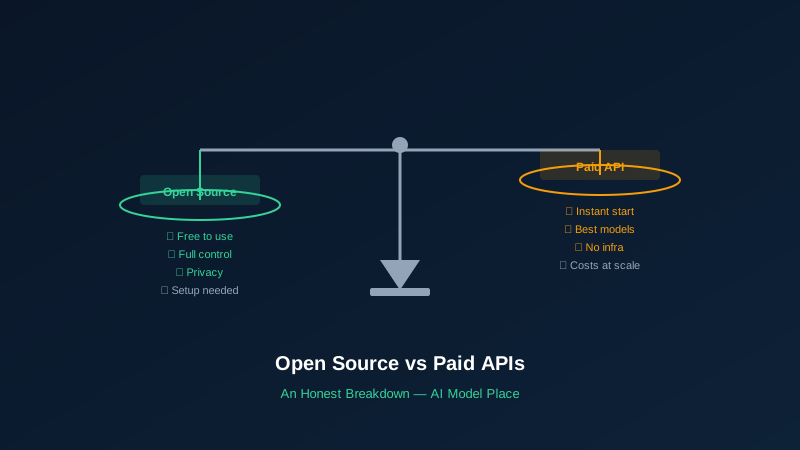
A few years ago, if you wanted serious AI capabilities, you paid for them through API access from one of a handful of companies. Now the open source landscape is genuinely competitive for a wide range of use cases. The choice between the two paths is less obvious than it used to be, and the right answer depends heavily on your specific situation.
The case for paid APIs
Speed to production is the strongest argument for paid APIs. You make HTTP requests and get results back. There is no infrastructure to provision, no model weights to manage, no GPU cluster to operate. For early-stage projects, prototypes, and small teams without dedicated machine learning engineers, this reduction in complexity matters enormously.
The latest proprietary models are also still ahead on the most demanding tasks. If you need top-tier reasoning ability, handling of very long documents, or nuanced instruction following across complex workflows, the leading closed models tend to outperform the best open alternatives on difficult benchmarks. That gap has narrowed significantly, but it still exists for the hardest tasks.
The case for open source
Cost at scale is the most compelling argument for going open source. API pricing is entirely reasonable when you are making a few hundred or a few thousand calls per day. When you are processing millions of requests monthly, the costs compound into a significant line item that can easily justify the engineering effort to self-host.
Data privacy and compliance is the other major driver. Healthcare organizations, financial institutions, and legal firms often cannot send sensitive data to external API endpoints for regulatory reasons. Open source models deployed on your own infrastructure keep data processing fully internal and within your control. For these industries, it is not really a cost calculation. It is a compliance requirement.
What the open source ecosystem looks like today
Models like Llama, Mistral, and Falcon have made genuinely capable open weights available to anyone. For many standard tasks such as summarization, classification, and question answering on your own documents, an open model running on modest hardware can get surprisingly close to the top proprietary options at a fraction of the ongoing cost.
The honest middle ground
Most serious production systems end up using both approaches. A paid API handles tasks that genuinely need the best available capability for quality-critical outputs. Open source models handle high-volume, lower-complexity tasks where cost and infrastructure control matter more than squeezing out the last few percentage points of quality. This is not hedging. It is matching the right tool to each specific task in a rational way.
The open source landscape in 2024 and beyond
Meta's Llama series represents the most significant contribution to the open source AI ecosystem in recent years. Llama 3, released in 2024, produced models competitive with the leading commercial options on many standard benchmarks, available to run on consumer-grade hardware for the smaller variants. Mistral AI's models have similarly demonstrated that strong performance is achievable at model sizes that do not require enterprise-grade compute infrastructure. The practical consideration that often gets overlooked is total cost of ownership rather than model cost alone. Hosting, monitoring, incident response, model updates, and the engineering time to maintain infrastructure are all real costs that need to be counted against the savings from avoiding API fees.
For teams evaluating self-hosting versus API access, a simple decision framework helps: if your monthly API bill is under a few thousand dollars, self-hosting is unlikely to save money when you factor in engineering overhead. If your monthly bill approaches five figures, the economics start to favor self-hosting for the high-volume workloads where you can control cost without sacrificing quality on tasks that do not require the best available model.
References & Further Reading