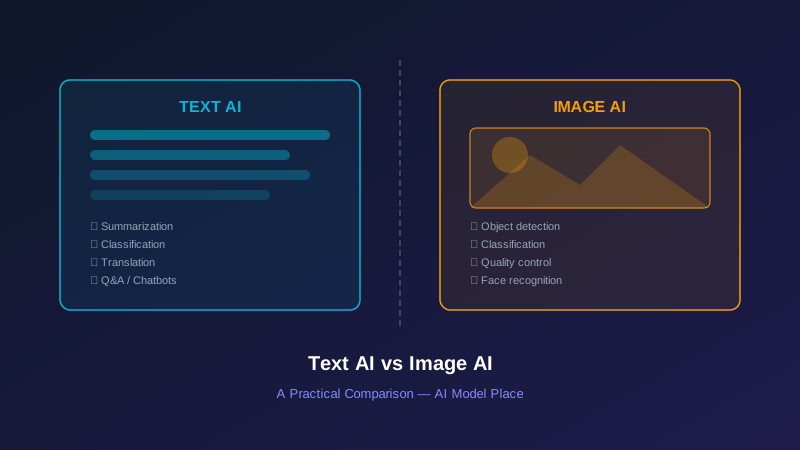
If you are building something with AI for the first time, one of the earliest decisions you face is what kind of data you are working with. Text and image are the two most common starting points, and they are different enough that the choice shapes your tooling, your data requirements, and your expected performance ceiling.
Text AI: what it does well
Language models have become remarkably capable over the past few years. Summarizing long documents, classifying text into categories, answering questions from a knowledge base, drafting content from a brief, translating between languages: modern text models handle all of these well, often without any custom training required.
The practical ceiling tends to be nuance and accuracy under pressure. Models do not truly understand what they are processing. They predict likely patterns based on training data. For most business tasks, that prediction quality is good enough. For tasks that require deep logical reasoning, access to private or real-time information, or understanding of specialized domain knowledge not covered in training, you will hit limitations sooner than the demos suggest.
Image AI: what it does well
Classification and detection are the workhorses of image AI. Is this product defective? Is there a person in this security camera frame? What species of plant is this? Image models answer these questions quickly and at a scale that would be impossible for humans to manage manually. A manufacturing line inspecting thousands of items per hour is a task that simply cannot be done any other way.
The main limitation is data. Good image models need labeled training images, often a substantial number of them. Getting to useful performance frequently requires either a large collection of labeled examples specific to your problem or an existing pre-trained model that is close enough to your domain to fine-tune effectively.
Accuracy versus volume tradeoffs
Text models tend to generalize better across domains because language is more universal than visual patterns. An image model trained on retail product photos will not perform well on medical scans without retraining. A text model trained on general web content often does reasonably well on specialized text with minimal adaptation. This is worth factoring into your build versus buy decision.
When you need both
Multimodal tasks that process images and text together are increasingly common and practical to build. Product catalog tools that accept a photo and generate a full description. Medical systems that analyze an image and produce a structured report. Insurance platforms that assess damage photos alongside written claim descriptions. These use cases combine both model types and add integration complexity, but the individual building blocks are well-established. The practical advice is to start with whichever modality is cleaner and more constrained for your specific problem, get that working well, and expand scope from a stable foundation.
The convergence toward multimodal systems
The clearest trend in AI development over the past two years is the move toward multimodal architectures that handle text, images, audio, and other data types within a single system. GPT-4o, Google's Gemini, and Anthropic's Claude all accept mixed inputs and produce mixed outputs. This convergence reduces the complexity of building applications that previously required separate models for separate modalities, with a custom integration layer connecting them. For most new application development, starting with a capable multimodal API is now simpler than assembling purpose-built models for each data type independently.
The specialization versus generalization tradeoff still applies at the edges. For high-stakes or high-volume tasks where a few percentage points of accuracy translates to meaningful business impact, purpose-built specialist models still outperform general multimodal systems on their specific domain. The practical question is whether your use case falls in the range where a good general model is sufficient, which covers more use cases than it did even two years ago.
References & Further Reading