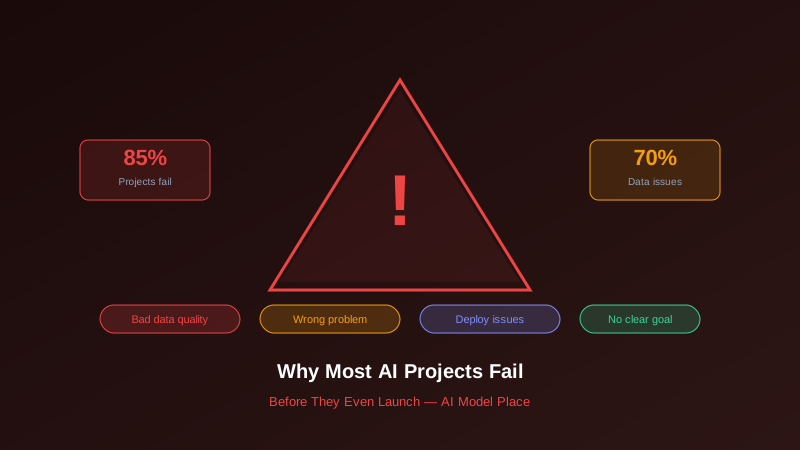
The failure rate on AI projects is genuinely high. Estimates range from 70 to 85 percent depending on who you ask and how they define failure. After watching a number of these projects up close, the reasons tend to cluster around a few consistent problems that show up repeatedly across industries and team sizes.
The data problem people consistently underestimate
Everyone knows data is important for AI. What people consistently get wrong is how much work goes into making raw data actually usable. Raw data is usually messy, inconsistently labeled, missing values in inconvenient places, and formatted in ways that were never designed with machine learning in mind.
Teams often spend 60 to 70 percent of a project timeline just cleaning and preparing data before any modeling even starts. When that reality is not factored into the project plan, timelines blow up, momentum dies, and stakeholders lose faith before the interesting work is even underway.
Starting with the solution instead of the problem
A lot of AI projects start with someone getting excited about a technology capability rather than a business problem worth solving. They build an impressive-looking model without first establishing that the problem is worth solving, that AI is the right tool for it, or that the organization can actually act on the model's outputs even if it works perfectly.
A model that correctly identifies at-risk customers is completely useless if the sales team has no different process for reaching out to them. The model is only as valuable as the action it enables.
Underestimating the deployment gap
Getting a model to work well in a Jupyter notebook during development is one thing. Getting it to work reliably in production with real traffic, real edge cases, inconsistent input formatting, and actual time constraints is a substantially different challenge. The teams that succeed treat deployment as part of the project from the very first week, not as an afterthought to tackle once the model accuracy looks good enough.
Organizational readiness is ignored
Technical readiness and organizational readiness are two completely different things. A model can be technically excellent and still fail because the people who need to use it were not consulted in its design, do not trust its outputs, or were never given proper training on how to interpret its recommendations. Getting the people side right matters as much as getting the model right.
No clear definition of success upfront
What does good actually look like for your use case? If that question cannot be answered clearly before the project starts, the team will not know when they have got there. Define your target metrics before building anything: accuracy, precision, recall, latency, cost per prediction, whatever applies to your situation. Teams that skip this step build models that perform well by arbitrary measures and fail by the ones that actually matter to the business.
What successful projects do differently from the first week
McKinsey's State of AI report has consistently found that organizations reporting the most significant value from AI share a few common characteristics: they treat AI as an ongoing capability rather than a one-time project, they invest in data infrastructure before model development, and they define business metrics rather than technical ones as the primary success measure. The teams that fail tend to do the opposite: treat AI as a project with a fixed end date, start with model selection before data assessment, and optimize for model accuracy rather than business outcome. The pattern is remarkably consistent across industries and company sizes.
A proof of concept scoped to four to six weeks, with a clear go/no-go criterion defined before it starts, is the most reliable way to validate whether an AI use case is worth full investment. The POC should use a small but representative sample of real production data, not synthetic examples. It should be evaluated by the people who will actually use the system in production. And it should end with a decision, not a request for another round of experimentation.
References & Further Reading