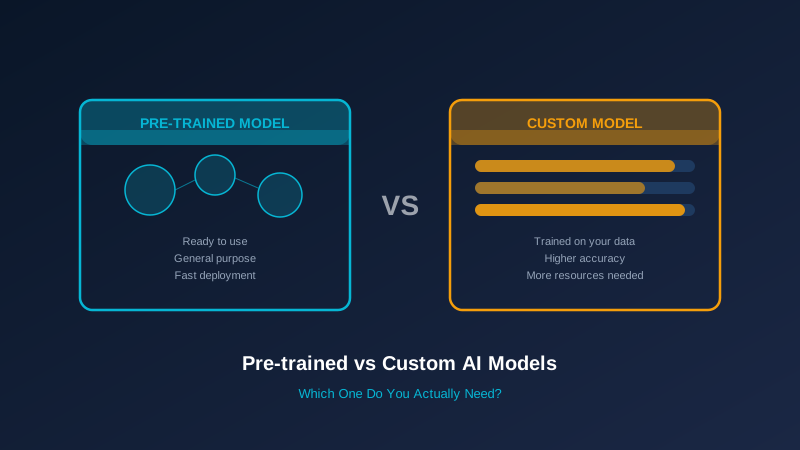
This question comes up constantly, and the honest answer depends on factors most guides either gloss over or treat as more complicated than they need to be. Here is a straightforward breakdown.
What pre-trained actually means
When a model is described as pre-trained, it means a team has already spent the significant compute budget required to train it on a large general dataset. Models like BERT for text understanding or ResNet for image recognition started as pre-trained models that research teams made publicly available. Using one means you skip the most expensive and time-consuming part of the development process.
The tradeoff is real: it was built for general use. It might handle 80 percent of your use case perfectly well and struggle noticeably with the remaining 20 percent that is specific to your industry, your terminology, or your particular edge cases.
When custom training is worth the investment
Custom training makes sense when your data is significantly different from what general models were originally trained on. Medical imaging is a classic example. The visual patterns inside an X-ray or MRI scan are different enough from everyday photographs that general image models perform poorly on them. A model trained specifically on radiology data consistently outperforms general image models on the same diagnostic tasks by a meaningful and clinically significant margin.
Custom training also makes sense when accuracy requirements are high and the cost of errors is real. A spam filter getting a few messages wrong is annoying but manageable. A model making decisions about loan approvals or medical diagnoses getting things wrong has actual consequences for real people's lives.
The middle path: fine-tuning
Most production use cases end up here, and for good reason. You take a pre-trained model and train it further on your own domain-specific data. You keep the benefit of the broad general knowledge the model already has, while adding the specificity your use case requires.
This approach is cheaper than training from scratch because you are starting from a model that already understands language or images at a general level. Fine-tuning on a few thousand well-labeled examples from your specific domain can close most of the performance gap between a general model and a fully custom one, at a fraction of the cost.
The practical decision rule
Start with a pre-trained model and test it on your actual data. If performance is good enough for your use case, ship it. If you consistently see it failing on specific types of inputs that matter to you, consider fine-tuning on examples of those failures. Only commit to training a model from scratch if fine-tuning a good pre-trained base genuinely cannot get you to where you need to be, which is rare outside of highly specialized domains.
Real cost comparisons between the approaches
Training a mid-sized language model from scratch typically requires millions of GPU hours and costs anywhere from several hundred thousand to several million dollars depending on model size, hardware, and training duration. Fine-tuning that same base model on a custom dataset of 10,000 examples might require 50 to 200 GPU hours and cost a few hundred dollars through cloud provider fine-tuning services. The cost ratio between the two approaches is in the range of 1,000 to 10,000 to one. For teams that are not AI research labs with specific reasons to train from scratch, fine-tuning from a strong base is almost always the economically rational choice.
The emergence of parameter-efficient fine-tuning techniques, including LoRA and QLoRA, has further reduced the cost and compute requirements of adapting large models. These methods update only a small fraction of a model's parameters during fine-tuning, reducing memory requirements enough that fine-tuning models that previously required expensive hardware can now be done on more modest infrastructure without significant performance degradation on the target task.
References & Further Reading