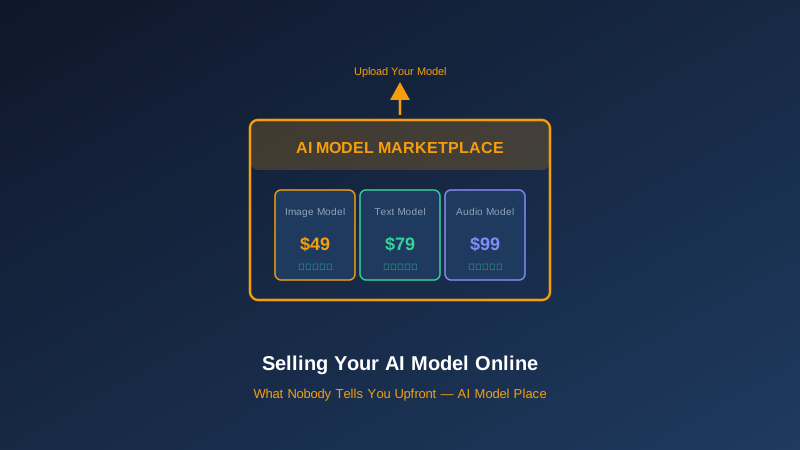
You built something that works. Your model performs well on your test set, it solves a real problem, and you think other people might find it useful. So you decide to sell it. Here is what that process actually looks like, and what most guides skip over.
Documentation matters more than the model itself
The single biggest thing separating models that sell well from those that sit unlisted is documentation. Buyers need to understand what the model does, what it was trained on, what its limitations are, and how to integrate it into their own systems. If that information is missing or vague, the overwhelming majority of potential buyers will move on without contacting you.
Write a clear description of the specific problem your model solves. Include performance metrics with enough context to be meaningful: 94 percent accuracy on what dataset, measured under what conditions, with what kind of input? Show a concrete sample input alongside the expected output. This is not optional detail. It is the difference between a sale and a bounce.
Pricing is harder than it looks
Most first-time model sellers either underprice because they are unsure of the value they have created, or overprice because they are proud of the technical work. Neither approach builds a sustainable product. Look at what similar models or tools charge for solving the same underlying problem. If your model saves a business ten hours of work per week, it is worth considerably more than a one-time fee of a few dollars.
Also consider the delivery model carefully. Are you selling a one-time download, API access on a subscription basis, or both? Subscription access tends to generate more long-term revenue and builds an ongoing relationship with customers. It does require you to maintain uptime, handle support requests, and keep the model functional as inputs evolve over time.
Your target buyer shapes everything
A developer buying a model wants an API, clean documentation, and sample code. A non-technical buyer wants a hosted solution with a simple interface. These are fundamentally different products even if the underlying model is identical. Getting clear on who you are selling to shapes your documentation, your pricing, your support load, and your integration story.
Be upfront about limitations
Buyers who discover limitations after purchasing become negative reviews and refund requests. Buyers who understood the limitations clearly before purchasing and chose to buy anyway become satisfied customers who recommend you to others. A model that works well on English-language text, stated clearly upfront, is a better product than one that makes no mention of language constraints and surprises buyers later.
The models that build lasting reputations are almost always the ones where the seller was straightforward about what the model does well and where it falls short. That honesty builds trust faster than any marketing language.
What actually drives sales on AI model marketplaces
Marketplace data consistently shows that models with detailed README documentation, example notebooks, and clearly stated performance benchmarks convert at a significantly higher rate than those with minimal descriptions. Response time to buyer questions also matters: sellers who answer enquiries within 24 hours see measurably better conversion rates than those who take several days. The technical quality of the model is table stakes. The purchasing decision often comes down to trust signals that buyers can evaluate before they can run the model themselves.
Versioning your model matters more than most sellers realize. When you update or improve a model, buyers who have already purchased want to know. Maintaining a changelog and communicating updates builds a base of returning customers who recommend you to others in their network. A model sold once to a satisfied customer who recommends it to two colleagues is worth considerably more long-term than a one-time transaction with no follow-on relationship.
References & Further Reading