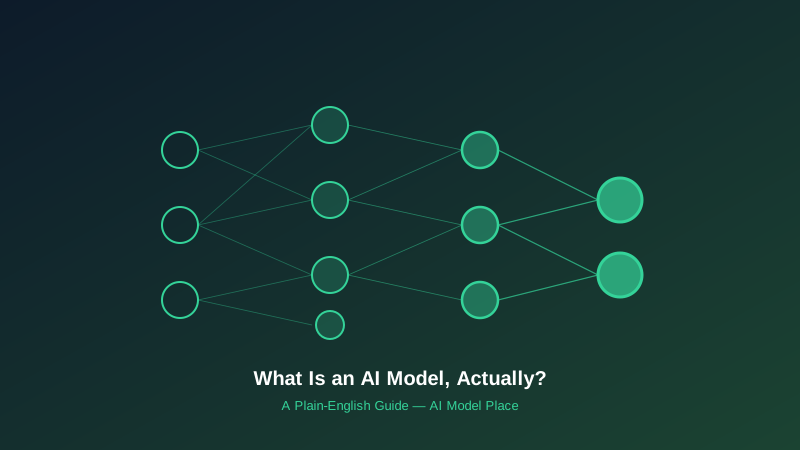
People throw the term AI model around constantly without explaining what it actually means. If you have ever nodded along while someone talked about deploying a model and had no idea what they were describing, this is for you.
Start with the basics
An AI model is a piece of software that has been trained to recognize patterns. That is it, at its core. You feed it a large number of examples, it figures out the patterns in those examples, and then it can apply what it learned to new data it has never seen before.
Your email spam filter is a model. It learned from millions of emails what spam looks like, and now it makes decisions on your inbox every day without you thinking about it. A recommendation system on a streaming platform is a model. It learned what shows you tend to watch, found patterns in your behavior, and uses those patterns to surface things you are likely to enjoy next.
Why there are so many different types
Different tasks require fundamentally different approaches. An image recognition model is built differently from a language model, which is built differently from a fraud detection model. The underlying mathematics shares some common ideas, but the architecture changes substantially based on what the model needs to do.
This is why you cannot take a model trained to identify cats in photographs and ask it to translate Spanish text. It knows nothing about language. It only understands visual patterns. The knowledge does not transfer between domains the way human learning sometimes does.
What training actually involves
Training a model means showing it thousands or millions of labeled examples and adjusting the model's internal settings until it gets better at making correct predictions. For an image classifier, that might mean showing it 100,000 labeled photos. For a language model, it might mean processing billions of words from books and websites. The scale differs, but the basic idea is the same.
Pre-trained versus custom models
A pre-trained model has already gone through that expensive training process, usually done by a research team or a large company. You can use it right away. The tradeoff is that it was trained for general use, so it may not handle the specific quirks of your use case perfectly.
A custom model is trained on your own data from scratch or fine-tuned from a pre-trained base. It takes more time and resources to build, but it can be significantly more accurate for your specific situation. A hospital training a model on its own patient records will usually outperform a general medical model because it has learned the patterns specific to that hospital's patient population and documentation style.
Most businesses start with a pre-trained model, test whether the performance is good enough, and only invest in custom training when the gap between good enough and excellent actually matters for the business outcome.
How models get from research labs to your applications
The practical pathway from a trained model to a deployed application has changed significantly in the past few years. Research organizations and companies now routinely release model weights or API access that developers can build on without replicating the original training process. Hugging Face, which hosts over 400,000 publicly available models as of 2024, has become a central distribution point for pre-trained models across text, image, audio, and multimodal tasks. This shift from models as proprietary assets to models as shared infrastructure has dramatically lowered the cost of entry for developers building AI-powered products.
Understanding this distribution layer matters if you are evaluating whether to build on existing models or train your own. The model itself is increasingly a commodity at the lower end of capability requirements. The differentiation comes from fine-tuning on proprietary data, the quality of the surrounding application, and the specificity of the use case the model is applied to.
References & Further Reading