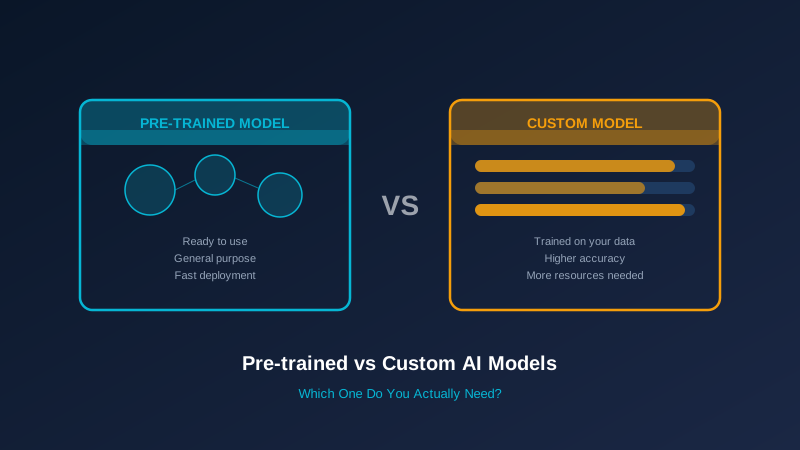
Fine-tuning is one of those concepts that gets mentioned frequently in AI discussions but rarely explained with enough practical specificity to be useful. This article covers what it actually involves, when it is worth doing, and what the process looks like for a team approaching it for the first time.
What fine-tuning is and is not
Fine-tuning takes a model that has already been trained on a large general dataset and trains it further on a smaller, task-specific dataset. You are not teaching the model everything from scratch. You are adjusting its existing knowledge to be more useful for your particular domain, style, or task.
Fine-tuning is not a magic fix for a fundamentally wrong model choice. If a base model performs terribly on your type of task even with good prompting, fine-tuning is unlikely to solve the problem. It improves a model that is roughly right to be more precisely right. It does not transform a model that is fundamentally mismatched to your use case.
When fine-tuning is worth considering
The clearest case for fine-tuning is when you have a highly specific style, format, or domain requirement that is difficult to reliably achieve through prompting alone. A legal firm that needs documents in a very precise format consistently. A medical platform that needs outputs to match specific clinical documentation standards. A customer service application that needs responses in a particular brand voice across thousands of daily interactions.
Fine-tuning is also worth considering when you need to significantly reduce latency or token costs. A well fine-tuned smaller model can often match the quality of a larger general model on a specific task, at lower inference cost and higher speed. For high-volume production use cases, that efficiency difference compounds meaningfully over time.
What you need before you start
A representative dataset of examples in the format you want the model to learn. For instruction fine-tuning, this typically means prompt-completion pairs: here is an input, here is what a good output looks like. The minimum viable dataset depends on the task and the base model, but as a rough heuristic, you need at minimum a few hundred high-quality examples to see meaningful improvement, and several thousand to see the full potential of fine-tuning on a specific task.
Data quality matters more than data quantity. A hundred carefully curated examples of exactly what you want often outperforms a thousand inconsistent or poorly labeled examples. The labeling work is real, and skimping on it produces fine-tuned models that confidently replicate your bad examples along with your good ones.
The practical process
Most cloud AI providers now offer fine-tuning interfaces that handle the infrastructure. You upload your training data in a specified format, configure a small number of training parameters, and the provider handles the actual compute. For most teams, this is the right starting point because it eliminates significant infrastructure complexity.
Expect to run several fine-tuning experiments rather than one. The first run tells you whether your data format and volume are sufficient. Subsequent runs let you adjust the training duration, evaluate the impact of adding more or different examples, and test whether the fine-tuned model actually outperforms good prompting on your specific evaluation set. Building that evaluation set before you start is important; it is what tells you whether each experiment made things better or worse.
Monitoring after deployment
Fine-tuned models need the same ongoing monitoring as any other model in production. Distributional shift, where the inputs you receive in production start diverging from your training distribution, will gradually degrade performance. The fine-tuning that worked well in month one may need revisiting in month six as your use case evolves. Building in a process for collecting production examples and periodically re-evaluating model quality is worth doing before you ship rather than after you notice a problem.
Dataset collection strategies that work in practice
For teams without an existing labeled dataset, the fastest path to fine-tuning data is usually a combination of three sources: examples generated by a larger general model and reviewed by a human who corrects them, historical records from your existing product that can be retrospectively labeled, and a small batch of examples created from scratch by domain experts who understand what good output looks like. The last category tends to be the most valuable per example. Expert-created examples teach the model the standard you want to reach. The other sources give it volume.
A practical workflow that many teams have found effective: define your output format precisely, generate 50 examples using a capable general model with detailed instructions, have a domain expert review and correct all 50, use those corrected examples to create a rubric for evaluating subsequent batches, then scale the collection and review process using that rubric. This approach produces higher-quality training data than collecting examples first and trying to define quality criteria afterward.
References & Further Reading