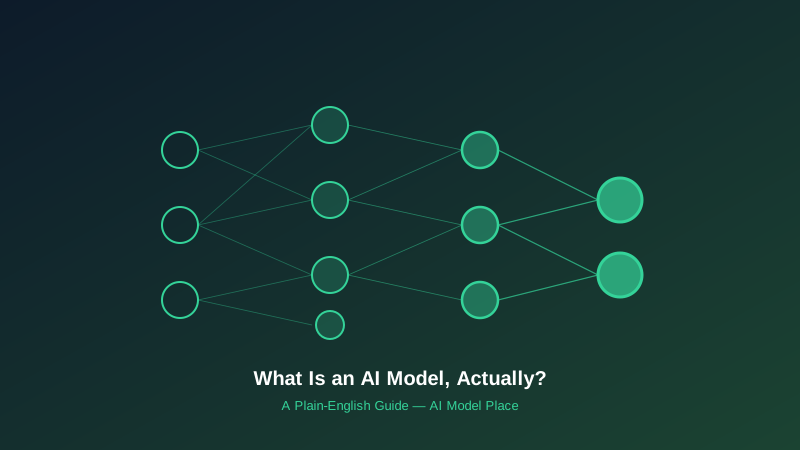
Generative AI became a household term in late 2022 when ChatGPT launched and reached a million users in five days. But despite how widely the term gets used, there is still a lot of confusion about what generative AI actually does differently from other AI, and why that difference matters for builders and businesses.
What makes it generative
Traditional AI models are mostly discriminative. You give them an input, they classify or predict something about it. Is this email spam? What product category does this item belong to? What is the probability this customer will churn? Discriminative models learn to draw boundaries and make decisions based on input data.
Generative models learn to produce new content. Text, images, audio, code, structured data: they generate outputs that did not previously exist rather than simply categorizing inputs that do. The same fundamental shift in what the model is doing has significant implications for what you can build with it.
How large language models actually work
Large language models are trained by processing enormous quantities of text from books, websites, code repositories, and other sources. During training, the model learns to predict what comes next in a sequence of text with increasing accuracy. That prediction task, run at scale across billions of parameters, produces a model that has effectively absorbed a compressed representation of a vast amount of human knowledge and can draw on it to generate coherent, contextually relevant text in response to prompts.
It is not understanding in the philosophical sense. The model is not reasoning about truth the way a human does. But the practical capabilities that emerge from this training are remarkable and genuinely useful for a wide range of real tasks.
What you can actually build with it
Content generation at scale: product descriptions, marketing copy, support documentation, email drafts, report summaries. Code assistance: generating boilerplate, explaining existing code, debugging, writing tests. Data extraction: pulling structured information from unstructured text at a scale that would not be feasible manually. Customer-facing chatbots that handle complex queries rather than simple keyword matching. Internal knowledge tools that let employees ask questions about company documentation and get useful answers.
None of these applications require the AI to be generally intelligent. They require it to be reliably useful for a specific, bounded task, which is a considerably more achievable standard.
The limitations worth taking seriously
Generative models hallucinate. They produce plausible-sounding text that is factually wrong with enough regularity that relying on them for high-stakes factual claims without verification is genuinely risky. This is not a quirk that will be entirely engineered away. It is a fundamental characteristic of how these models work.
They also do not have memory across conversations by default, they do not have access to real-time information unless explicitly given tools to retrieve it, and their performance degrades on tasks that require sustained logical reasoning across many steps. Building with these limitations in mind produces better products than pretending they do not exist.
Why it matters for builders right now
The practical implication for anyone building software products is that a category of features that previously required teams of specialists or simply could not be built now has a viable, accessible implementation path. Integrating a language model through an API is a software engineering problem that a small team can tackle. That shift in what is buildable by whom is the genuinely important thing, more than any specific product capability.
Retrieval-augmented generation: solving the knowledge cutoff problem
One of the most practically important architectural patterns for building production language model applications is retrieval-augmented generation, or RAG. The core idea is straightforward: instead of relying solely on what a model learned during training, you retrieve relevant information from a current knowledge base at query time and include it in the model's context. This addresses two of the main limitations of language models at once: outdated training data and lack of access to proprietary or internal information.
A RAG system typically involves storing documents as vector embeddings in a database, running a similarity search when a user query arrives to find the most relevant passages, and including those passages in the prompt sent to the language model. The model then generates a response grounded in the retrieved content rather than relying purely on its training knowledge. For enterprise applications where the content that matters is internal documentation, product specifications, or current data, RAG is now a standard pattern rather than an advanced technique. Frameworks like LangChain and LlamaIndex have made it accessible to developers who are not ML specialists.
References & Further Reading