Buying a pre-built AI model can save significant time and development cost compared to building one from scratch. But models vary enormously in quality, and buying the wrong one wastes both the purchase price and the integration effort. Here is what to ask before committing to anything.
What was it trained on?
This is the single most important question and the one buyers most frequently skip. The training data determines what the model understands, what it performs well on, and where it will fail in ways that surprise you in production. A model trained primarily on general English web text will struggle with industry-specific terminology, structured data formats, or non-English inputs. Ask for specifics about the training dataset, not just the phrase 'trained on a large dataset,' which tells you essentially nothing about whether it will work for your use case.
What are the actual performance numbers, and how were they measured?
Ask for precision and recall on a held-out test set, not just an overall accuracy figure. Ask what dataset the test numbers came from and whether the test set was completely held out from training or not. Ask how the model performs on examples that look like your actual data. These questions sound technical, but any serious model developer should be able to answer them clearly and without hesitation. Vague or evasive answers to basic performance questions are a meaningful warning sign.
Test it on your own inputs before buying
Request a trial or at minimum ask the seller to run a sample. Give them three to five inputs that are representative of your real use case and ask to see the outputs. This tells you more about fit than any benchmark number on a marketing page. If a seller cannot or will not do this reasonable thing, that is itself useful information about how the ongoing relationship will go.
How does it fail?
Every model is wrong sometimes. The question is not whether it fails but how it fails. Does it fail silently with a confident but incorrect answer, giving you no way to catch the error downstream? Or does it produce a confidence score or uncertainty estimate that lets you filter out low-confidence predictions before they reach users or downstream systems? The latter is substantially easier to build a reliable product around in production environments.
What is included for integration?
Is there a documented API? Working sample code in the language your team uses? Clear documentation about input formats, output schemas, and rate limits? A technically impressive model with no integration support will cost your team significant developer time regardless of how good the underlying model is. Factor that hidden cost into your total cost comparison when evaluating options at different price points.
What are the licensing terms?
Can you use the model in a commercial product? Are there restrictions on deployment at scale? Can you fine-tune it on your own data? These licensing questions matter considerably more once you are in production and trying to scale, and they are much easier to clarify before purchase than after you have built a dependency on the model in your product.
A condensed buyer checklist
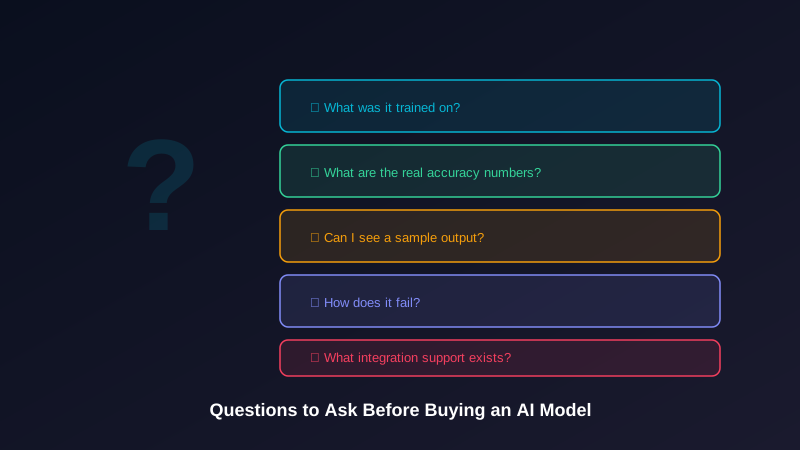
Before committing to any AI model purchase, work through these questions: What specifically was the model trained on and how representative is that of my use case? What are the precision and recall numbers on a held-out test set, not just overall accuracy? Can I test it on five to ten real examples from my own data before buying? How does it fail: silently with high confidence, or with uncertainty scores that let me filter? Is there working documentation and integration support, or will I be debugging from scratch? What are the licensing terms for my intended use case, specifically regarding commercial deployment and fine-tuning? Getting clear answers to all of these before purchase takes a few hours of due diligence. Skipping them and discovering problems after integration takes significantly longer to unwind.
Google's model card format, originally proposed in a 2019 research paper, has become the de facto standard for documenting what a model does, what it was trained on, and where it performs poorly. Well-documented models following this format give buyers the information they need to make an informed decision. Models without this kind of structured documentation are significantly harder to evaluate before purchasing.
References & Further Reading