Text and image AI dominate the headlines and the developer conversations. Audio has been quietly catching up, and for a growing set of applications it is now genuinely practical and cost-effective to build with. The interesting thing about audio AI is that it tends to solve problems that were previously just accepted as unsolvable at scale.
Speech recognition has crossed a meaningful threshold
A few years ago, speech-to-text was notoriously unreliable with accents, background noise, overlapping speakers, or technical and industry-specific vocabulary. That changed noticeably around 2022 and has continued improving. Open source models like Whisper handle these conditions well enough that transcription accuracy has stopped being the main limiting factor for most practical applications.
The range of applications this opens up is significant. Automated meeting transcription. Voice interfaces for software products. Accessibility tools for people who cannot type. Call center analytics that process thousands of hours of recordings to find patterns in customer complaints. All of these improved substantially when transcription accuracy crossed a usability threshold.
Speaker diarization: who said what
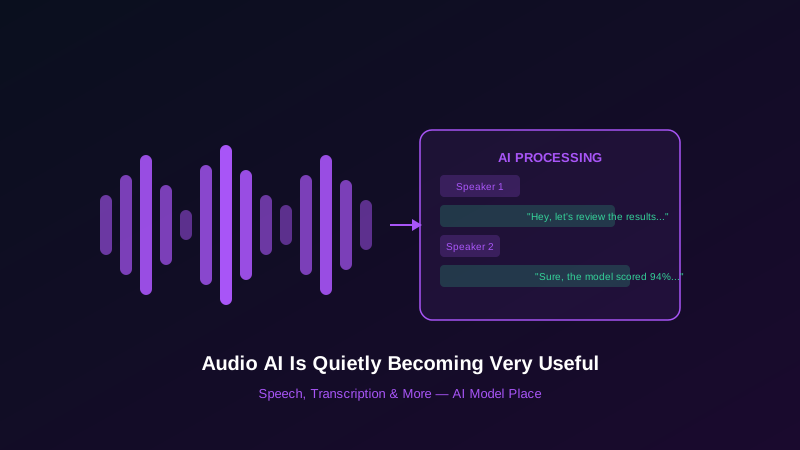
Diarization sounds technical but the concept is straightforward. Given a recording with multiple speakers, the model labels who said what, producing a structured transcript rather than a single undifferentiated block of text. This is what makes automated meeting transcripts actually readable and useful.
Legal depositions, podcast editing, job interview documentation, earnings call analysis: anyone who regularly works with multi-person recordings will immediately recognize the value of having this problem handled automatically rather than manually.
Emotion and tone detection in voice
Beyond the words themselves, audio models are increasingly capable of detecting emotional tone, stress levels, and sentiment in speech. Call centers use this to flag frustrated customers in real time and route them to experienced agents. Mental health researchers use it to monitor patient progress between sessions. These applications are sensitive and require careful implementation, but they address real problems that text-based analysis of the same conversations misses entirely.
Non-speech audio classification
Models that classify non-speech audio are more niche but solve genuinely valuable problems in specific industries. Detecting mechanical anomalies from the sound of industrial equipment, such as a bearing beginning to fail before it causes a breakdown, is a real and growing industrial maintenance application. Healthcare monitoring of breathing patterns during sleep studies. Security systems that classify audio events like breaking glass or unusual impacts. Audio AI is not going to have a consumer moment that makes front-page news, but it is building a track record as a reliable and practical tool across a broad range of industries.
What you can build right now with available audio AI tools
OpenAI's Whisper, released as an open source model in 2022, processes audio and returns transcripts with accuracy that handles most accents and significant background noise well enough for most practical applications. It is freely available, runs on consumer hardware for shorter audio files, and handles over 90 languages. For developers who have been waiting for audio transcription to be production-ready before building around it, that threshold has been crossed. The model is not perfect, but it is good enough for a wide range of real products.
The combination of Whisper for transcription, a diarization library for speaker separation, and a language model for downstream processing creates an audio analysis pipeline that would have required a team of specialists and significant infrastructure investment five years ago. That same pipeline can now be assembled by a software developer working alone, using open source tools, in a matter of days. The barrier to building audio-aware applications has dropped substantially, which means the competitive advantage window for early movers is also narrowing.
References & Further Reading