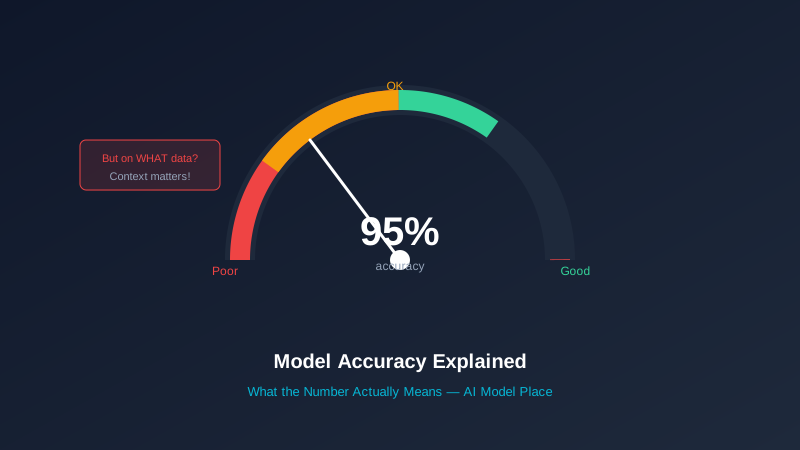
When someone says their AI model has 95 percent accuracy, it sounds impressive. Sometimes it genuinely is. Sometimes it means almost nothing at all. The number alone does not tell you much without understanding the context behind it. Here is what to actually look for when evaluating model performance.
The class imbalance problem
Imagine you are building a fraud detection model. In a typical transaction dataset, 99 percent of transactions are legitimate and 1 percent are fraudulent. A model that predicts 'not fraud' for every single transaction regardless of the input would achieve 99 percent accuracy. It would also be completely useless, missing every fraud case in the dataset entirely.
This is the class imbalance problem, and it is why accuracy as a single headline number misleads people on a regular basis. When one class is far more common than the other in the data, accuracy inflates dramatically without communicating anything useful about whether the model can actually detect what you need it to detect.
Precision and recall: the more useful pair
Precision answers the question: when the model predicted yes, how often was it actually right? Recall answers: out of all the genuine positive cases in the dataset, what fraction did the model correctly identify? These two metrics in combination give a much more honest picture of model performance than accuracy alone.
For a fraud detection use case, recall matters more than precision. Missing a fraudulent transaction is more costly than generating a false alarm that a human investigates. For a spam filter, precision often matters more. Users tolerate occasional spam getting through far better than they tolerate important emails being incorrectly blocked and lost.
The F1 score as a single-number compromise
When you need a single number that balances both precision and recall, the F1 score is the standard choice. It is the harmonic mean of the two metrics, which means it penalizes models that are strong on one but weak on the other. A model with 95 percent precision and 30 percent recall looks very different on accuracy versus F1, and F1 gives you the more honest picture for most classification tasks.
Accuracy on what data, measured how
A model's reported accuracy number is only meaningful in relation to the specific dataset it was tested on. A model trained and evaluated on data from the same source will often look excellent on paper while performing considerably worse on data from a different distribution in the real world.
When someone shows you a model's accuracy number, the three most useful follow-up questions are: accuracy at what specific task, measured using what methodology, and on what data collected from where. Those three questions catch the majority of misleading performance claims before you commit to using or buying the model.
Building your own evaluation framework
For teams building production ML systems, a minimal evaluation framework should include: a fixed held-out test set that is never used for training or hyperparameter tuning; performance metrics disaggregated by the most important subgroups in your data; a tracking system that records metric values every time the model changes so you can detect regressions; and a clear threshold below which performance is considered unacceptable and deployment is blocked. This is not complex engineering. It is discipline applied consistently.
Scikit-learn's documentation on model evaluation provides an accessible technical reference for classification metrics including confusion matrices, ROC curves, and the relationship between precision, recall, and threshold selection. The conceptual foundations are straightforward and understanding them is valuable regardless of which framework you ultimately build with. Making decisions about deployed models without understanding these metrics is roughly equivalent to navigating with a map you do not know how to read.
References & Further Reading