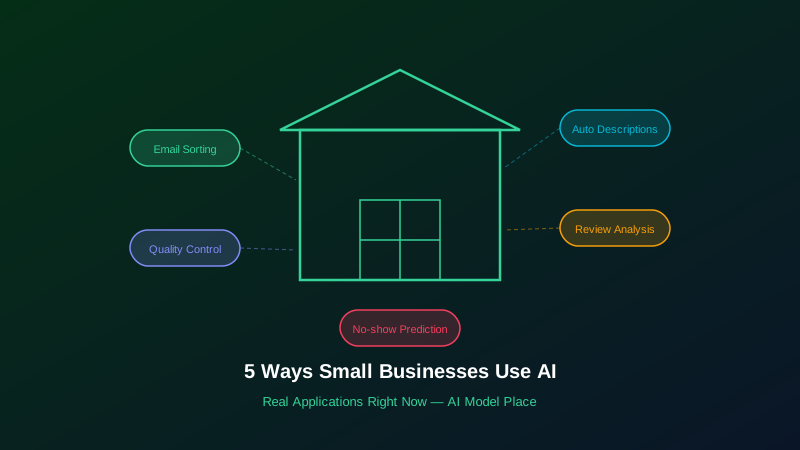
There is a significant gap between how AI gets discussed in the press and how most small businesses are actually using it. The press version involves world-changing transformation and revolutionary technology. The small business version is usually boring, practical, and quietly effective. Here are five real applications worth understanding.
1. Automating product descriptions
E-commerce sellers with large product catalogs are using text generation models to draft product descriptions from a structured set of specs. A human reviews the output and makes edits, but the model handles the first draft. For shops with hundreds or thousands of products, this compresses days of writing work into hours. The quality is good enough to need editing, not rewriting, which is what makes it genuinely useful rather than just a curiosity.
2. Customer email categorization and routing
A text classification model reads incoming customer emails and routes them to the right team: billing, technical support, returns, general inquiries. No human sorting is required. Small support teams consistently report that this single change saves several hours of administrative work per week. The model does not need to be perfect. It just needs to be right enough often enough that it reduces the manual burden on the team.
3. Quality control in small manufacturing
Small manufacturers are using image classification models to flag defective products on production lines. A camera captures each item as it passes, the model checks it against the expected specifications, and anything outside acceptable tolerances gets flagged for human review. The hardware and software setup cost has dropped far enough that this is no longer only viable for large operations with dedicated automation teams.
4. Customer review and feedback analysis
Sentiment analysis models scan customer reviews, support tickets, and social media mentions, surfacing recurring themes and flagging emerging negative patterns. Instead of reading through hundreds of reviews manually every week, an owner receives a structured summary of what customers are saying, what has improved, and what is getting worse. This kind of ongoing signal is genuinely valuable for businesses that did not previously have a systematic way to process customer feedback at scale.
5. Appointment no-show prediction
Service businesses including salons, medical clinics, and professional consultancies are using predictive models to anticipate no-shows based on booking history and client behavior patterns. The model flags high-risk appointments, allowing the business to send targeted reminders or adjust overbooking levels accordingly. Businesses that have implemented this report measurable improvement in appointment utilization rates without meaningfully increasing the administrative burden.
None of these applications are flashy or headline-worthy. All of them save real time and real money for the businesses using them, which is what actually matters when the novelty of a new technology wears off.
What implementation actually looks like for most small businesses
The MIT Sloan Management Review's survey on small and medium business AI adoption found that the most common first AI tool adopted was not a custom model but an AI-enhanced feature within software the business already used: a CRM with predictive lead scoring, an accounting platform with anomaly detection, or an email platform with smart reply suggestions. The jump from using an AI feature within existing software to building something custom is significant, and most small businesses do not need to make it to capture meaningful value from AI.
The practical playbook for a small business exploring AI for the first time involves identifying one repetitive, rule-following task that consumes significant staff time, testing an off-the-shelf tool against that specific task for 30 days with a clear evaluation criterion, and making a data-driven decision about whether the time saved justifies the cost and change management effort. That sequence produces better outcomes than a broader AI strategy initiative that tries to transform multiple processes simultaneously.
References & Further Reading